
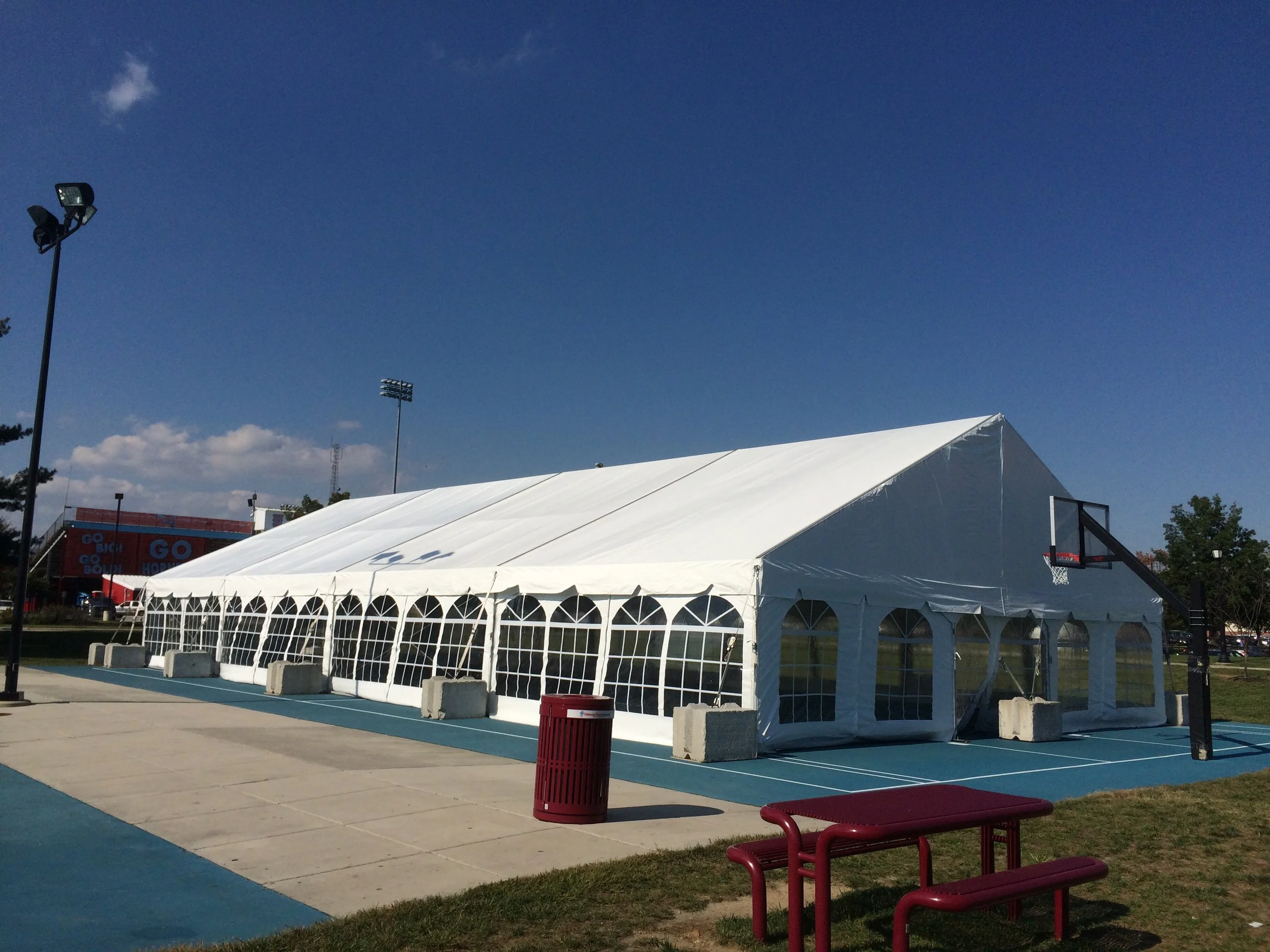
Staking vs. Ballasting: How to Safely Secure Frame Tents and Clearspan Tents with Concrete Weights
Staking is always the best way to anchor a tent, but when it's not possible, proper concrete block ballasting is essential. Discover Tents For Rent's standard weight recommendations for common frame and clearspan tent sizes and best practices to keep your event secure.
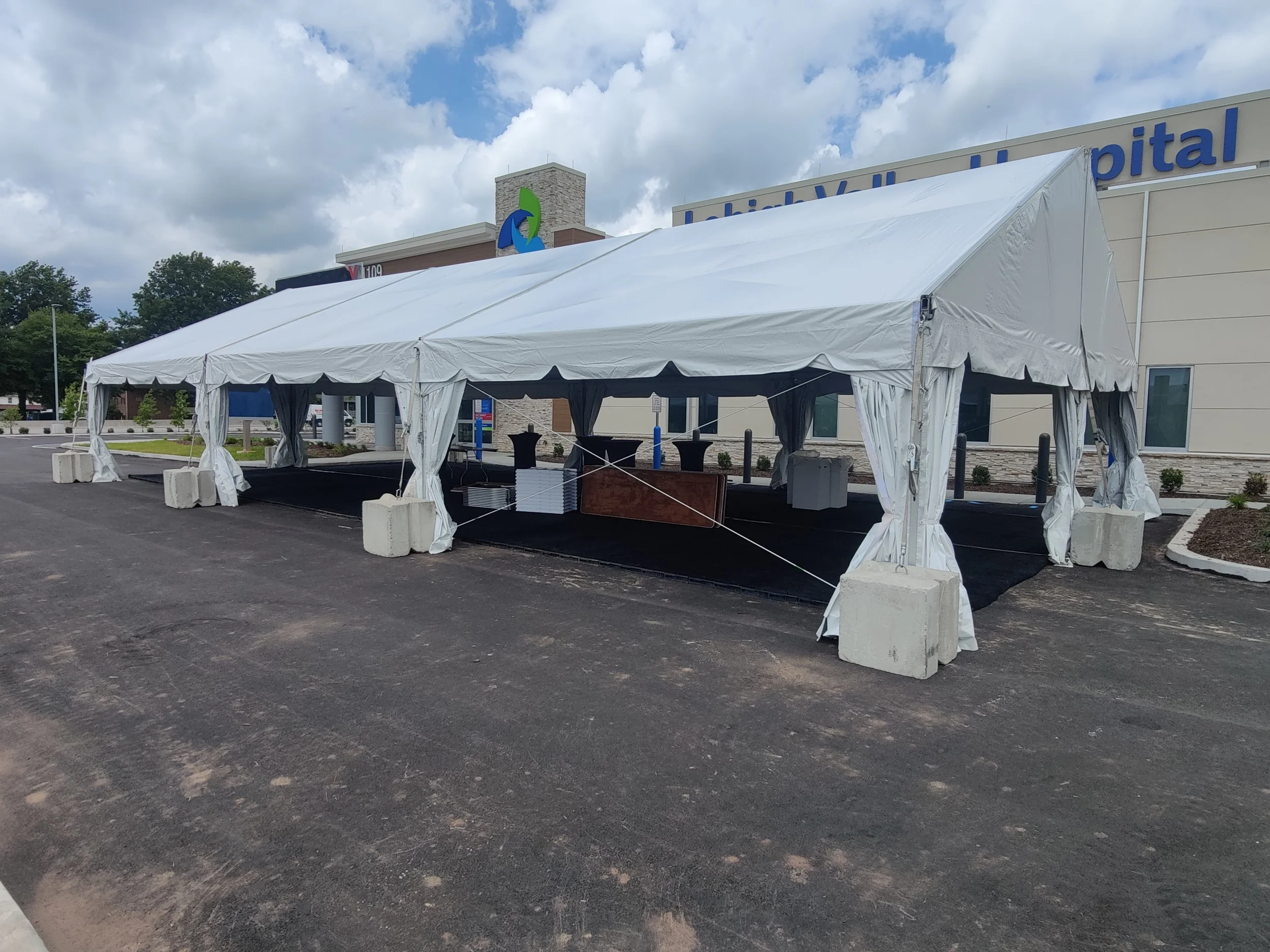
Proper anchoring is essential for the safety of any tent installation. Staking remains the best and most effective method whenever soil conditions permit. It delivers superior resistance to wind uplift and lateral forces at a lower cost. However, on hard surfaces like concrete, asphalt, or sites where staking is restricted by permits or utilities, concrete block ballasting is the reliable alternative for both frame tents and clearspan tents.
Tents For Rent always prioritizes staking when possible and uses ballasting solutions only when necessary.
Why Proper Weighting Matters
Frame tents and clearspan tents offer larger unobstructed spaces and the ability to be installed without stakes. Insufficient ballast risks uplift, shifting, or collapse. Industry standards (e.g., from ARA/ATA guidelines) emphasize calculating ballast based on tent size, wind exposure, surface, and other variables.
Key Disclaimer: These are standard recommendations under normal circumstances. Each installation must be adjusted for specific location, event duration, anticipated wind speeds, ground/surface conditions, sidewalls, and other factors. Tents For Rent provides site-specific guidance; always comply with local codes and manufacturer specs. Contact us for a professional assessment.
Frequently asked questions:
-
Sand bags are not a safe way to secure a tent. They don’t weigh enough, and they don’t have a safe attachment point.
-
Water barrels are not an ideal way to secure a tent. The plastic slides easily in a storm, and water can leak out of them, reducing their weight.
-
The price of a ballasted frame tent is approximately 3 times the cost of a similarly sized staked pole tent.
-
While there are many factors that determine how much weight a tent requires, a good rule of thumb is 10 pounds of ballast per square foot of tent.
Tents For Rent Standard Ballast Recommendations
We recommend solid concrete blocks (typically 500 lb, 1,100 lb, or 1,600 lb units) properly secured to tents. Here are our guidelines for common sizes:
| Tent Size (feet) | Tent Size (meters) | Qty 500 lb | Qty 1,100 lb | Qty 1,600 lb | Total Weight (lbs) |
|---|---|---|---|---|---|
| 10x10 | - | 2 | - | - | 1,000 |
| 10x20 | - | 4 | - | - | 2,000 |
| 15x15 | - | 4 | - | - | 2,000 |
| 20x20 | - | 8 | - | - | 4,000 |
| 20x30 | - | 10 | - | - | 5,000 |
| 20x40 | - | - | 8 | - | 8,800 |
| 20x50 | - | - | 10 | - | 11,000 |
| 20x60 | - | - | 12 | - | 13,200 |
| 30x30 | - | - | 8 | - | 8,800 |
| 30x40 | - | 2 | - | 10 | 17,000 |
| 30x50 | - | 2 | - | 12 | 20,200 |
| 30x60 | - | - | - | 14 | 22,400 |
| 40x40 | - | - | 4 | 6 | 14,000 |
| 40x50 | - | - | 4 | 8 | 17,200 |
| 40x60 | - | - | - | 12 | 19,200 |
| 40x70 | - | - | - | 14 | 22,400 |
| 40x80 | - | - | 4 | 14 | 26,800 |
| 40x90 | - | - | 4 | 16 | 30,000 |
| 40x100 | - | - | - | 20 | 32,000 |
| 40x110 | - | - | - | 24 | 38,400 |
| 40x120 | - | - | - | 26 | 41,600 |
| 40x130 | - | - | - | 26 | 41,600 |
| 40x140 | - | - | - | 30 | 48,000 |
| 65x49 | 20M x 15M | - | 6 | 30 | 54,600 |
| 65x65 | 20M x 20M | - | 6 | 36 | 64,200 |
| 65x82 | 20M x 25M | - | 6 | 42 | 73,800 |
| 65x98 | 20M x 30M | - | 6 | 48 | 83,400 |
Note: Quantities and totals reflect standard installs. Larger clearspan structures often require significantly more ballast due to their design.
Cost Considerations
Switching from a pole tent (staked) to a weighted frame or clearspan tent roughly triples the price due to the additional equipment, transportation, and labor for safe ballasting. This investment ensures compliance and guest safety. Sometimes a frame tent can be installed in such a way that a portion of the tent can be secured by stakes. This can reduce cost significantly. For example, when a tent is installed on asphalt, sometimes we can locate the tent along the edge of the asphalt and drive stakes into the grass.
Best Practices for Concrete Block Ballasting
Use purpose-built concrete blocks.
Secure blocks directly to tent legs to prevent shifting.
Monitor weather forecasts and adjust as needed.
Concrete blocks outperform water barrels, which can slide, leak, or lose effectiveness.
For detailed engineering or custom scenarios, we rely on proven tools and our extensive experience with commercial, government, and industrial events.
Situations that require ballasting:
Asphalt where staking is not allowed
Astroturf sports fields
Decks and patios. Sometimes, stakes can secure these tents around the perimeter.
Boardwalks
Parking garages
When there is insufficient time to locate underground utilities before installing the tent
Where there are so many underground utilities that no stakes may be driven into the ground
On building rooftops. In this situation, the building must be engineered to support the weight of the tent structure and the required weights. The additional height and wind exposure also requires more weights than a standard installation.
Ready for your next event? Contact Tents For Rent LLC for expert advice, precise ballasting plans, and reliable rentals serving PA, NJ, MD, DE, WV, and surrounding areas. Safety is our priority—stake when you can, ballast correctly when you must.
This information is general guidance based on industry standards and our experience. It is not a substitute for site-specific engineering or local regulations.
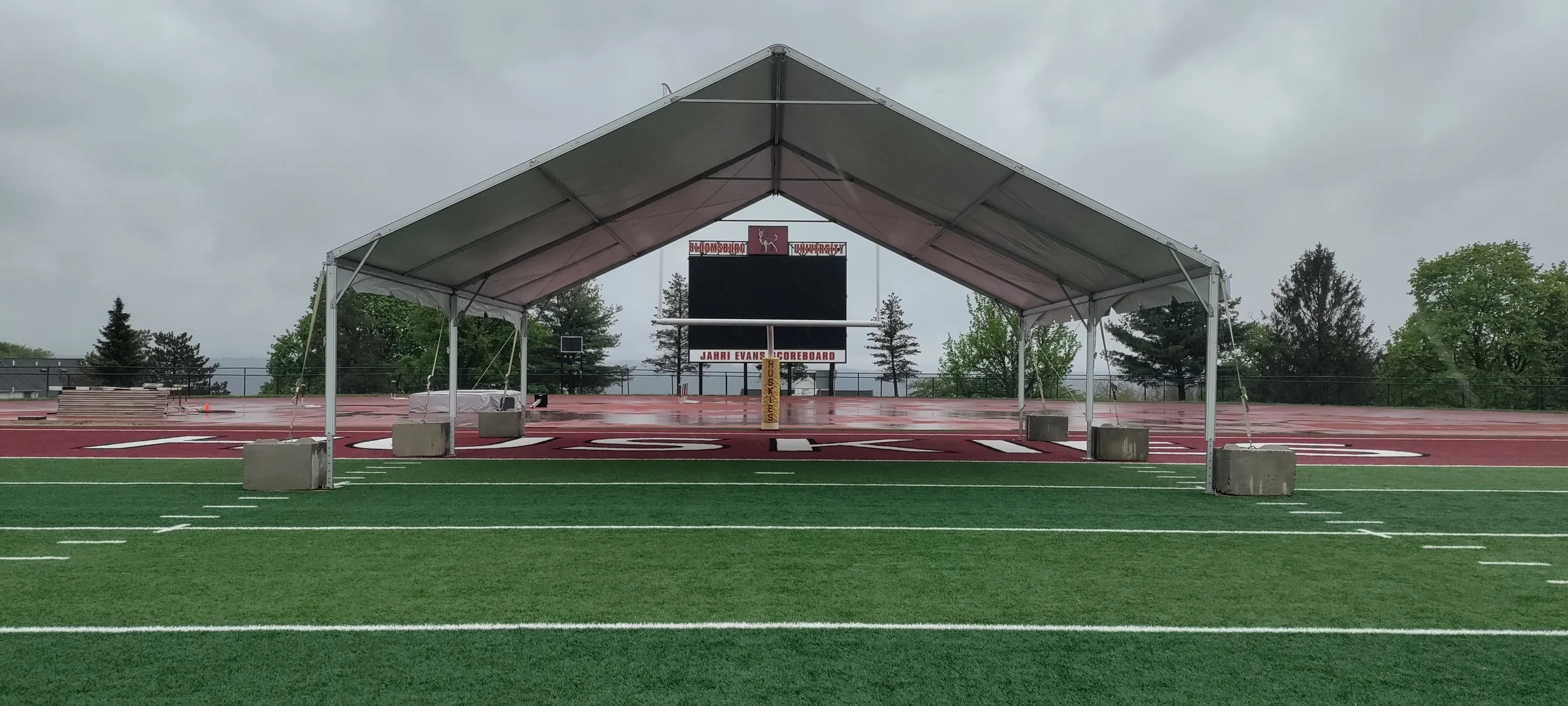

How we patch holes in asphalt video
When we install tents on asphalt, we can secure them with concrete weights or by driving stakes into the asphalt.
After we remove the stakes, we repair the holes by filling them with crushed stone and topping off the hole with asphalt cold patch.
When we install tents on asphalt, we can secure them with concrete weights or by driving stakes into the asphalt. Most customers choose to have us drive stakes into the blacktop because it’s more economical, faster and more secure.
After we remove the stakes, we repair the holes by filling them with crushed stone and topping off the hole with asphalt cold patch. Then we tamp it down with a sledgehammer.
This creates a durable patch that is barely noticeable. Over time, it fades and becomes even less noticeable. Often when we come back a year later to install a tent at the same location, it’s difficult for us to find the holes to reuse them.
Do you need a tent installed on asphalt? Contact us to order today.